



Telecom Company condemns the targeting of the telecommunications building in the city of Al Hudaydah
July 31, 2023
Telemen signs an exclusive partnership agreement with “Universal Sat Net” company to organize and provide internet services via satellite in Yemen
July 1, 2025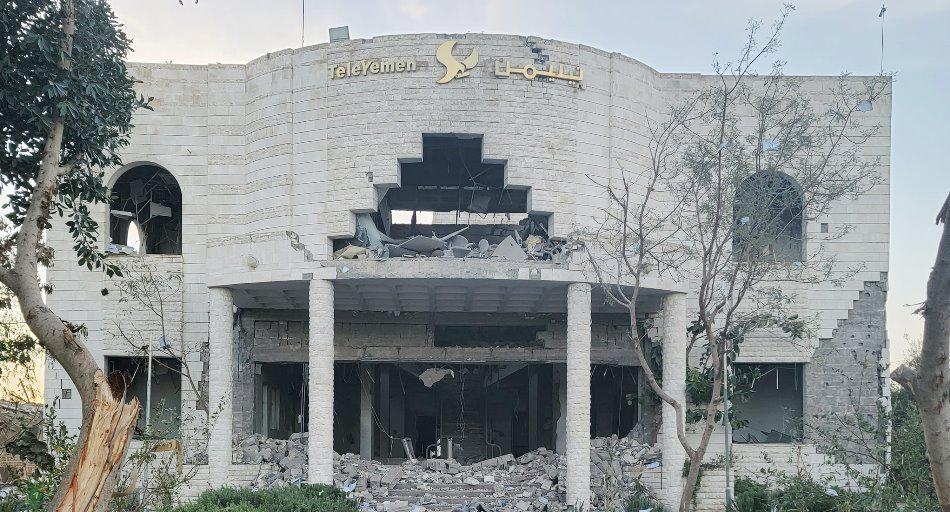
Statement issued by the Ministry of Communications and Information Technology
The Ministry of Communications and Information Technology today revealed the preliminary material losses incurred by the telecommunications and postal sector and companies due to the military and economic aggression, amounting to more than ten billion and 925 million dollars, equivalent to more than six trillion and 550 million Yemeni riyals.
This came during a press conference held by the Ministry of Communications and Information Technology today on the eighth anniversary of the National Day of Resilience, to disclose the losses of the telecommunications and postal sector during eight years of American-Saudi aggression and blockade.
At the conference, attended by the Minister of Communications and Information Technology, Engineer Masfer Al-Namir, the Deputy Minister of Communications for Financial and Administrative Affairs, Ahmed Al-Mutawakkil, revealed that the Ministry of Communications has adopted paths of construction and resilience as a historic national responsibility, which contributed to achieving successes reflected in maintaining telecommunications and internet services and continuing to provide them to citizens.
He pointed out that the Ministry of Communications’ directives announced the introduction of fourth-generation services across all telecommunications institutions and companies, and that the postal sector has witnessed significant improvements in its services and is preparing to launch the first phase of digital transformation projects.
A statement issued by the Ministry of Communications confirmed that the aggression targeted and destroyed 1,106 civilian telecommunications and postal facilities in a systematic manner, and according to precise coordinates, they were targeted with more than 2,760 raids, resulting in the death of more than 79 martyrs among workers in the telecommunications and information technology sector and companies.
The statement pointed out that 706 facilities were completely destroyed, while severe partial damage was inflicted on 400 civilian facilities. The aggression also caused the closure and suspension of services at more than 862 telecommunications and postal facilities, which resulted in isolating more than 114 Yemeni villages and cities from the world, with no regard for the fate awaiting millions of civilians in Yemen.
It explained that the aggression has so far aimed to prevent the reactivation of destroyed telecommunications stations and sites, and to thwart the restoration of services to the affected areas, either through the continued ban on telecommunications equipment and systems for civilian use and preventing their entry into Yemen, or by resuming targeting of the sites that have been restored to service.
He reported that the coalition of aggression continues to prevent the use of submarine internet cables to this day: the Aden-Djibouti submarine cable, the (AAE-1) submarine cable and its landing station in Aden, as well as preventing the installation and operation of the (SMW5) cable and its unloading station in Hodeidah owned by Yemen Telecommunications after it became ready for operation, which caused Yemen to be deprived of projects to develop telecommunications and internet services.
According to a statement from the Ministry of Communications, the aggression continued to target the technical, technological, and administrative systems of telecommunications companies and institutions, either by attempts to thwart the development of companies and expand the coverage of their services, or by establishing suspicious entities aimed at fragmenting the national telecommunications network, isolating the eastern and southern governorates, and damaging Yemen’s international internet gateway. The latest of these was preventing one of the mobile phone companies from introducing fourth-generation technology to the governorates under the occupation’s control.
He explained that the aggressor countries, as part of their systematic economic war against the telecommunications sector, continue to detain more than 104 telecommunications stations, nearly seven million mobile phone SIM cards, and 20 containers carrying telecommunications and communication equipment and devices, which have been stopped and detained at airports and ports under their control and that of their mercenaries.
The statement confirmed that the aggression continues to close air, land, and sea ports to postal services; no mail has reached Yemen since 2016.
The statement estimated the initial material losses incurred by the telecommunications and postal sector and companies due to the military and economic aggression at more than ten billion and 925 million dollars, equivalent to more than six trillion and 550 million Yemeni riyals.
The Ministry of Communications and Information Technology held the countries of the American-Saudi aggression coalition fully legally and morally responsible for all crimes committed against the Yemeni people in general, and against the telecommunications and postal network infrastructure in particular, and for all catastrophic consequences resulting from those crimes.
The ministry renewed its call to the international community, UN organizations, and human rights and humanitarian organizations to fulfill their duties and bear their responsibilities regarding the practices, violations, and crimes of the aggression, calling on the free people of the world, free global organizations, and international mediators to intervene quickly and work seriously to stop all forms of aggression and destruction.
It urged the United Nations and relevant international organizations to fulfill their legal responsibility to pressure the aggressor countries to lift the siege and open land, sea, and air entry points for the entry of telecommunications equipment and devices for civilian use.
Meanwhile, the Executive General Manager of the Public Telecommunications Corporation, Engineer Sadiq Maslah, explained that the Telecommunications Corporation has been systematically targeted for eight years, with the number of raids on the corporation’s infrastructure reaching 1,251 raids; accounting for 45 percent of the total raids on the telecommunications sector.
He explained that the catastrophic effects on civil society, due to targeting the institution, resulted in 1,642 facilities being unable to benefit from telecommunications and internet services, and more than 1,271,000 people being deprived of telecommunications and internet services. He pointed out that the losses of the telecommunications institution due to eight years of aggression amounted to more than two billion dollars.
Musleh confirmed that the most prominent features of resilience over eight years were represented in implementing projects to restructure the institution, the fourth generation (4G) network, Yemen WiFi wireless internet, fiber optic internet for homes (FTTH), integrated billing (CBS), and the project to deploy and update the national fiber optic network.
Meanwhile, the Director General of the General Authority for Post, Ammar Wahan, indicated that the authority was subjected to 79 airstrikes over eight years, with 27 postal facilities being directly destroyed, and 20 facilities suffering severe and partial damage, with losses exceeding 609,757,000 dollars.
He mentioned that the postal service pursued a path of reconstruction based on the project of the martyred president Al-Samad, “A hand that protects… and a hand that builds,” through the authority’s continued efforts to rehabilitate and maintain 86 post offices, restore postal services to 73 villages and districts that had been deprived due to the aggression, reactivate 17 suspended postal and financial services, and activate 34 ATMs.
For his part, the CEO of Yemen International Telecommunications Company “TeleYemen,” Dr. Ali Naji Nasari, referred to the losses the company suffered, most notably the destruction of the international internet gateway building due to a direct airstrike in Al Hudaydah Governorate, and the targeting and complete destruction of the company’s building in Sana’a.
He pointed out that the company was targeted by the aggression through the cloning of a fake company to disrupt the work of “TeleYemen,” but the aggression failed in that. He explained that the company continuously works to cover Yemen’s telecommunications and internet needs, as it is the main provider of telecommunications and internet.
Meanwhile, the Chairman of the Board of Directors of Yemen Mobile Company, Essam Al-Hamli, reviewed the systematic targeting by the aggression of the company’s tower sites, which reached 141 sites in 19 governorates.
He stated that the company worked on rehabilitating 51 sites, including 40 that were rehabilitated for the second time, and the total losses of the company over eight years amounted to 1,681,421,000 dollars. He pointed out the resilience of Yemen Mobile Company by continuously providing services, transitioning to the fourth generation (4G), and expanding the central equipment for the centers and control units.
Meanwhile, the Technical and Engineering General Manager of Sabafon Company, Engineer Nizar Al-Muayyad, referred to the losses the company suffered over eight years, most notably the separation of the company in the south of the country from the central administration in Sana’a.